
Most people need their wisdom teeth removed, and the sooner you know where things stand, the easier the process is. At McGann Oral Surgery in San Diego, Dr. Grant McGann evaluates your third molars, explains exactly what’s happening, and removes them safely using local anesthesia or IV sedation.
If your dentist has flagged your wisdom teeth, or if you’re starting to feel pressure, pain, or swelling in the back of your jaw, call the office to schedule a consultation.
Why Wisdom Teeth Cause Problems
Wisdom teeth are your third set of molars. They typically appear between your late teens and early twenties — long after the rest of your teeth have settled into place.
For most people, there simply isn’t enough room for them. When that happens, a few things can go wrong:
Impaction — The tooth gets stuck below the gumline and can’t break through. Left alone, this can cause swelling, infection, and damage to the tooth beside it.
Partial eruption — The tooth comes through halfway, leaving a flap of gum tissue where food and bacteria collect. This leads to recurring pain and infection.
Crowding — Even fully erupted wisdom teeth can shift your other teeth out of alignment, especially if you’ve had braces or other orthodontic work.
Decay and gum disease — Wisdom teeth sit in a spot that’s nearly impossible to clean well. Cavities and gum infections can spread to neighboring teeth.
Cheek irritation — Upper wisdom teeth sometimes grow sideways, pushing into the inner cheek every time you chew or talk.
Lack of space — Some wisdom teeth grow in at an angle and press against the adjacent molar, causing pain and potential bone loss over time.
Not every wisdom tooth needs to come out right away. Some can be monitored over time with regular X-rays. During your consultation, Dr. McGann will tell you clearly which situation you’re in — and what he recommends.
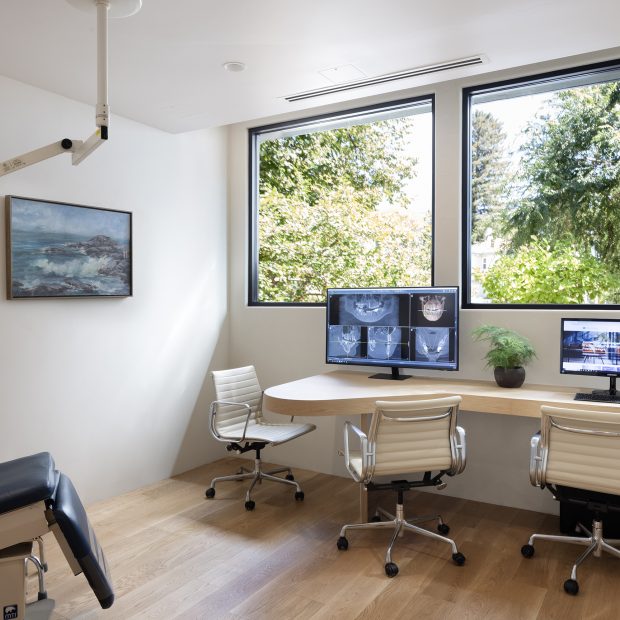
The artwork in the office was created by Dr McGann’s family including grandmother Nancy McGann.
How Dr. McGann Evaluates and Removes Wisdom Teeth
Not every patient needs the same solution. Dr. McGann places several types of implants depending on how many teeth are missing, your bone condition, and your long-term goals.
Step 1: Oral Exam and X-Rays
The American Association of Oral and Maxillofacial Surgeons supports early evaluation — ideally in the mid-teenage years — because younger patients heal faster and complications are less likely. Dr. McGann reviews your dental X-rays and examines the position of each tooth, looking at both current problems and what’s likely to develop.
Step 2: CT Imaging When It Matters
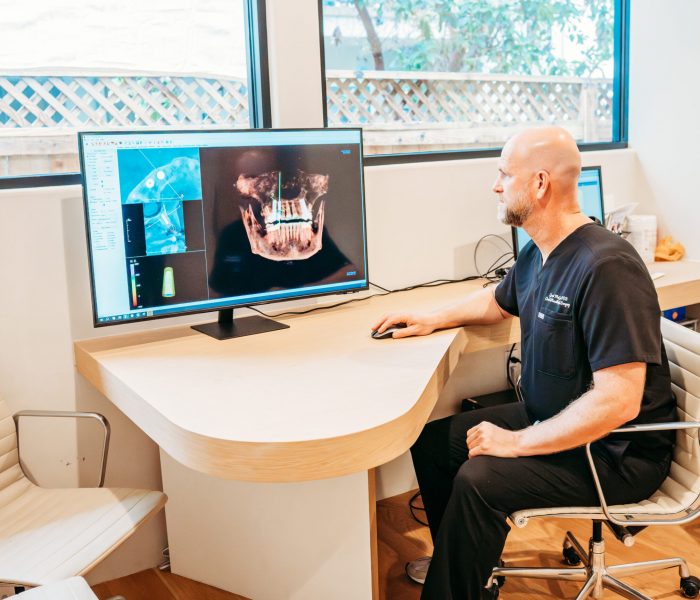
For impacted teeth, Dr. McGann may take an in-office CT scan to check how close the tooth’s roots are to the inferior alveolar nerve, a nerve that runs through the lower jaw. This step helps avoid preventable complications before surgery begins, not after.
Step 3: Removal Under Anesthesia
Wisdom teeth are removed under local anesthesia, oral conscious sedation, or IV/deep sedation — whichever is appropriate for your case and your comfort level. You can read more about anesthesia options provided at McGann Oral Surgery if you want to know what to expect before the day of surgery.
Before the procedure, Dr. McGann will walk you through the specific surgical risks for your case. For wisdom teeth, those can include temporary sensory nerve changes or, for upper teeth, sinus-related complications. Both are uncommon and will be explained clearly at your consultation.
After surgery, you’ll rest in the office until you’re ready to go home with your trusted driver. You’ll leave with gauze, an ice pack, post-operative instructions, and a prescription sent directly to your pharmacy. A follow-up appointment is available if needed. See what to expect after wisdom tooth removal with our full recovery guide.
Wisdom teeth removal at McGann Oral Surgery is done entirely in-office. The surgical suite uses modern monitoring equipment, and every team member is trained in anesthesia recovery. Learn more about how we keep you safe during surgery.
About Dr. Grant McGann
Dr. Grant McGann is a board-certified oral and maxillofacial surgeon and a Diplomate of the American Board of Oral and Maxillofacial Surgery. He’s been treating patients in San Diego since 2008, with referrals from dentists and orthodontists across Hillcrest, Mission Hills, Bankers Hill, North Park, and surrounding neighborhoods.
Ready to find out what your wisdom teeth actually need? Call the office at (858) 874-8181 to schedule an initial consultation.
Do You Accept Insurance for Wisdom Teeth Removal
Yes. Wisdom teeth removal is covered under dental insurance at McGann Oral Surgery. The practice is in-network with most major PPO dental plans, including Aetna, Ameritas, Anthem Complete, Blue Shield of CA, Cigna, Delta Dental, Guardian, MetLife, Principal, United Concordia, and several others.
If your plan isn’t listed or you’re uninsured, the practice sees out-of-network and self-pay patients at reduced rates. For PPO plans with out-of-network benefits, the office will handle claim submission on your behalf.
Enrique, our financial services coordinator, has been with the practice since 2008. Before your procedure, he’ll walk you through exactly what your plan covers and what to expect out of pocket. See the full list of insurance plans we accept.
Frequently Asked Questions
Do all four wisdom teeth have to come out at the same time?
Not necessarily. Dr. McGann evaluates each tooth individually. In many cases, removing all four at once makes sense — one recovery period, one anesthesia session. But if only one or two are causing problems, he’ll discuss whether removing all four is the right call for your situation.
How long does recovery take after wisdom teeth removal?
Recovery typically takes 7–10 days. Most patients notice the most swelling and discomfort around days 3–4 before things start to improve. Strenuous activity should be avoided for the first 48 hours — after that, you can ease back into normal routines as you feel ready. See the full recovery guide for a day-by-day breakdown of what to expect.
What anesthesia options are available?
Wisdom teeth removal at McGann Oral Surgery can be performed under local anesthesia, nitrous oxide, or IV sedation. Dr. McGann will recommend the right option based on the complexity of your case and your comfort level.
Will I be able to drive myself home?
If you choose IV sedation or another form of general anesthesia, you’ll need someone to drive you. If you’re having the procedure under local anesthesia only, this may not apply — confirm with the office when you schedule.
At what age should wisdom teeth be evaluated?
The AAOMS recommends evaluation in the mid-teenage years. Earlier evaluation gives more treatment options and typically means faster healing if removal is needed. Adults of any age can have their wisdom teeth evaluated — it’s never too late to get a clear picture of what’s happening.
What are the risks of not removing impacted wisdom teeth?
Impacted teeth that stay in place can cause recurring infections, damage the adjacent molar’s roots, or develop cysts that affect the surrounding bone. Not every impacted tooth needs immediate removal, but leaving them unmonitored isn’t advisable. Dr. McGann will give you an honest assessment of the risk level in your specific case. You can also learn more about other tooth extractions we perform if a different approach is recommended.

Not Sure If Your Wisdom Teeth Need to Come Out?
That’s exactly what the consultation is for. Dr. McGann will take a look, review your imaging, and give you a straight answer — whether that’s removing them now, scheduling for later, or simply monitoring. Either way, you’ll leave knowing where you stand.
McGann Oral Surgery is located at 3861 Front Street, San Diego, CA 92103 — get directions.