
Most changes inside your mouth are harmless. But some aren’t — and the difference between catching oral cancer early and catching it late can be significant. Dr. Grant McGann, a board-certified oral and maxillofacial surgeon in San Diego, evaluates suspicious lesions, patches, and oral abnormalities and can determine whether further testing is needed. If something in your mouth looks or feels off and hasn’t resolved in two weeks, schedule an evaluation.
What Is Oral Pathology?
Oral pathology is the study and diagnosis of diseases affecting the mouth, jaw, and surrounding structures. The inside of a healthy mouth is lined with smooth, coral-pink tissue called mucosa. Any change in that appearance — color, texture, or surface — can be an early sign of a pathological process. The most serious concern is oral cancer. But not every abnormality is cancer, and not every lesion requires immediate treatment. What matters is getting an accurate evaluation so you know what you’re dealing with.
Warning Signs to Watch For
These changes can appear on the lips, cheeks, palate, gum tissue, tongue, face, or neck. Contact Dr. McGann if you notice any of the following:
Red patches (erythroplasia) — Bright red areas inside the mouth that can’t be explained by irritation or injury
White patches (leukoplakia) — White or grayish patches that can’t be wiped away
A sore that won’t heal — Any sore that bleeds easily and hasn’t resolved within two weeks
A lump or thickening — An unexplained mass or hardening along the inner lining of the mouth
Difficulty chewing or swallowing — Persistent difficulty that has no obvious cause
Facial or oral pain without a clear reason — Pain that doesn’t trace back to a known dental issue
Oral cancer does not always cause pain in the early stages. Many patients with early-stage oral cancer have no discomfort at all. A visual change — a patch, a sore, a lump — is often the only sign. That’s why a monthly self-examination and prompt evaluation of anything unusual matters.
What to Expect at Your Evaluation
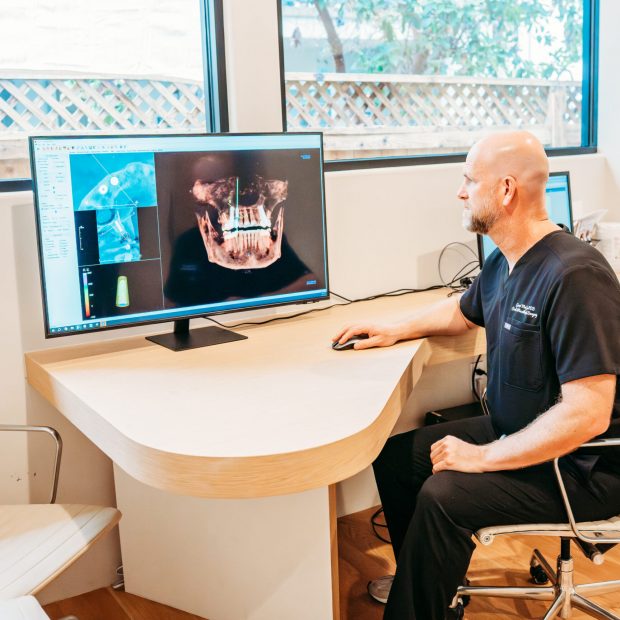
Dr. McGann examines the soft tissue of the mouth, looking at color, texture, and any areas that appear abnormal. If a lesion looks suspicious, a biopsy may be recommended to determine whether the tissue is benign, pre-cancerous, or malignant.
Early evaluation gives you the most options. The earlier a pathological process is identified, the more straightforward the treatment path tends to be.
Dr. Grant McGann is a board-certified oral and maxillofacial surgeon
The specialist most trained to evaluate and manage oral pathology. Oral and maxillofacial surgeons receive specific training in the diagnosis and surgical management of diseases affecting the mouth, jaw, and facial structures, making them the appropriate specialist for evaluation of suspicious oral lesions.
How to Perform a Monthly Oral Self-Exam
You don’t need any equipment — just good light and a mirror. Check once a month:
- Look at your lips and the front of your gums
- Tilt your head back and examine the roof of your mouth
- Pull your cheeks out gently and check the inner lining on both sides
- Pull your tongue out and check all surfaces — top, bottom, and sides
- Feel along the floor of the mouth and under the jaw for any lumps
If you notice anything that wasn’t there before and hasn’t resolved in two weeks, call the office.
About Dr. Grant McGann
Dr. McGann is a Diplomate of the American Board of Oral and Maxillofacial Surgery and a member of AAOMS, CALAOMS, and CDA. He completed his OMS residency at Washington Hospital Center in Washington, D.C. and has been serving San Diego patients since 2008.
Does Insurance Cover Oral Pathology Evaluations?
Most dental PPO plans cover evaluations and biopsies related to oral pathology. McGann Oral Surgery is in-network with Aetna, Anthem Blue Cross, Blue Shield of CA, Cigna, Delta Dental, Guardian, Humana, MetLife, United Healthcare, and other major PPO dental plans. See the full list of insurance plans we accept.
Our office is located at the corner or Front St & University Ave in the Hillcrest area (near Mission Hills).
Parking at our office is free and located on the back side of our building on Front Street, including one disabled parking space. Our main entrance is around the corner of the office on University Ave.
The artwork in the office was created by Dr McGann’s family including grandmother Nancy McGann.
Frequently Asked Questions
What's the difference between a canker sore and something that needs to be checked?
Canker sores are small, round ulcers that typically heal on their own within 7–14 days. A lesion that hasn’t healed after two weeks, bleeds easily, or looks unusual in color or texture warrants an evaluation. When in doubt, get it checked — early evaluation costs nothing compared to late detection.
Is oral cancer common?
Oral cancer accounts for roughly 3% of all cancers diagnosed in the U.S. each year. Risk factors include tobacco use, heavy alcohol consumption, HPV infection, and prolonged sun exposure to the lips. However, oral cancer can occur in patients with none of these risk factors — which is why self-examination and prompt evaluation of any unusual change matters regardless of lifestyle.
Does an abnormal-looking patch always mean cancer?
No. Many oral lesions are benign — caused by irritation, infection, or inflammatory conditions. A biopsy is the only definitive way to determine whether a lesion is benign, pre-cancerous, or malignant. Dr. McGann will let you know whether a biopsy is necessary based on his evaluation.
How long does an oral pathology evaluation take?
The exam itself is non-invasive and typically straightforward. If a biopsy is needed, Dr. McGann will explain the process and timeline before proceeding.
Can I come in without a referral?
Yes. No referral is required to schedule an evaluation at McGann Oral Surgery. If you’ve noticed something unusual and want it looked at, call the office directly.
Don’t Wait on Something That Could Matter
Most mouth sores are nothing. But the ones that aren’t respond far better to treatment when they’re caught early. If something in your mouth looks or feels different and hasn’t gone away, that’s enough reason to come in.
McGann Oral Surgery is located at 3861 Front Street, San Diego, CA 92103 — get directions.